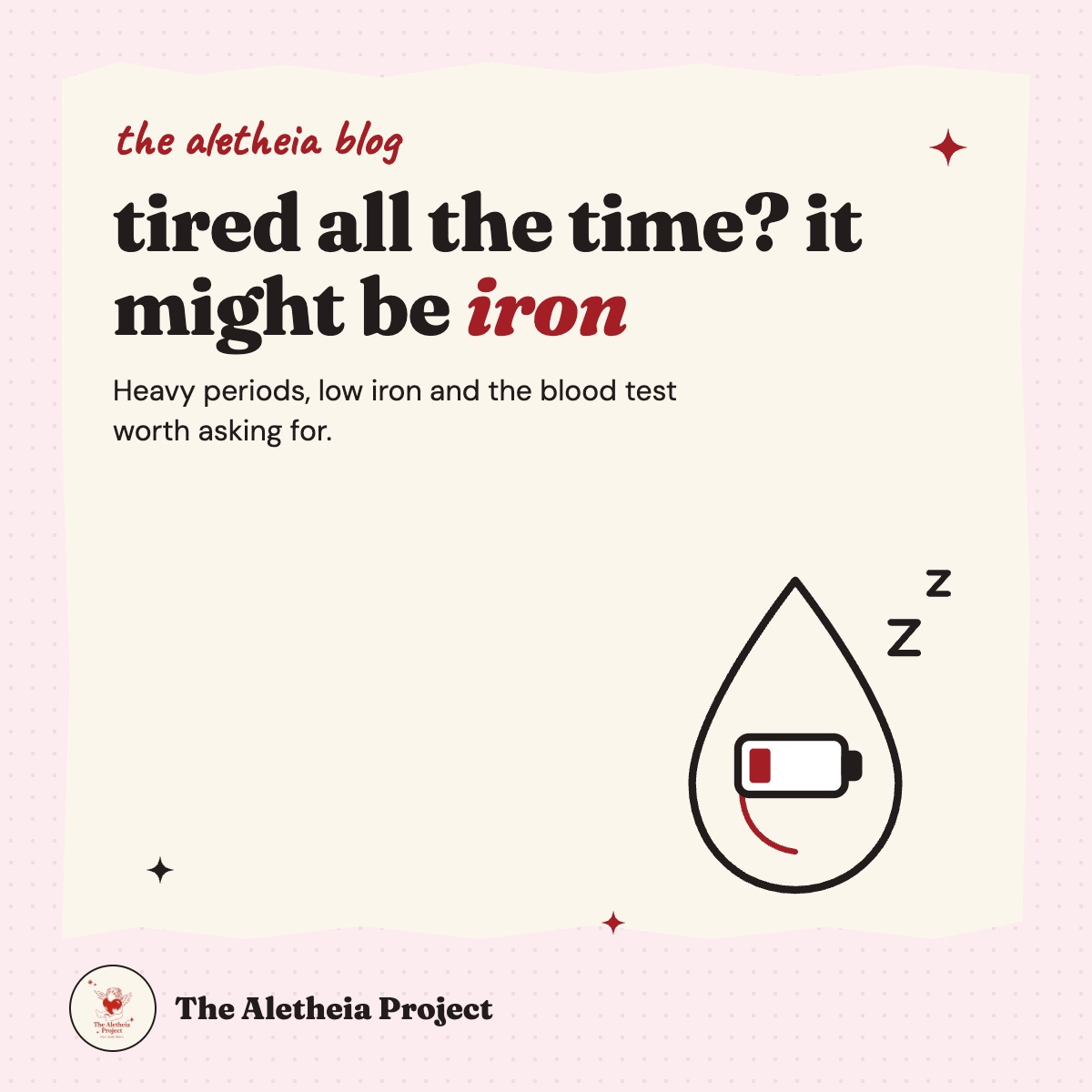
“always tired”: iron, heavy periods and the test worth asking for
You fall asleep on the bus home. You get dizzy when you stand up too fast. Stairs leave you puffed in a way they never used to. And every month, your period seems to take over your whole week.
Most of us have been told some version of “you’re a teenager, of course you’re tired.” Sometimes that’s true. Late nights, exams, growing bodies: it adds up. But sometimes tiredness has a reason you can actually test for. One of the most common, and most overlooked, is low iron.
This one is practical. What iron does, why heavy periods drain it, how to tell if your period counts as heavy, and how to ask a GP for the right test.
What iron actually does
Iron helps your body make haemoglobin, the part of your red blood cells that carries oxygen around your body. When iron runs low, your muscles and brain get less of what they need.
According to healthdirect, iron deficiency can cause fatigue, poor concentration and anaemia. Other signs include weakness, shortness of breath, dizziness or light-headedness, pale skin, irritability, and doing worse at school or work than usual.
Notice how ordinary that list sounds. “Tired, a bit foggy, cranky.” Those are exactly the symptoms people brush off in teenagers, which is part of why low iron can go unnoticed for so long.
Why teen girls are more at risk
Your body needs more iron during the teenage years. The Better Health Channel lists the recommended daily intake as 15 mg for girls aged 14 to 18, compared with 11 mg for boys the same age. That gap exists because of periods.
healthdirect names heavy menstrual periods as a common cause of iron deficiency. Every period means some iron leaves your body, and when bleeding is heavy, your diet may not keep up with what you lose.
Other things can raise the risk too. The Better Health Channel lists teenage girls, people with heavy periods, vegetarians and vegans, athletes in training and regular blood donors among those more likely to run low. Conditions that affect absorption, such as coeliac disease, can also play a part.
So what counts as a “heavy” period?
Here’s the tricky part. If your periods have always been heavy, heavy is your normal. Nobody hands you a measuring cup at 12 and says “this is the average.”
healthdirect says a period may be heavy if you:
- pass blood clots larger than a 50 cent coin
- need to change your pad or tampon every 1 to 2 hours
- need to change your pad or tampon overnight, or put a towel on your bed
- bleed through your clothes
- bleed for more than 8 days
- can’t do the things you’d normally do while you have your period
Jean Hailes for Women’s Health describes heavy periods as a common problem for teenagers, and estimates heavy periods affect about one in four women. It also notes that many wait years, even decades, before getting help.
In the teenage years, healthdirect explains, heavy periods are often linked to cycles where no egg is released, which is common while hormones are still settling. Jean Hailes also lists bleeding disorders, such as von Willebrand disease, as one possible cause. That’s another reason heavy bleeding deserves a proper check rather than a shrug.
Being tired all the time is not a personality trait. It’s information, and you’re allowed to ask what it means.
The test worth asking for
You can’t diagnose low iron by how you feel. healthdirect says the only reliable way to confirm iron deficiency is a blood test called iron studies, which can also check for anaemia.
That means it is completely reasonable to walk into a GP appointment and say something like:
“I’ve been really tired for a few months, I get dizzy when I stand up, and my periods are heavy. I change my pad every couple of hours on my heaviest days. Could my iron be low? Can I have iron studies done?”
That one sentence does a lot of work. It names your symptoms, gives the doctor a concrete detail about your bleeding, and asks a specific question. Specific questions are much harder to wave away than “I just feel off.”
If you’re 15 or older you can book your own appointment with your own Medicare card, and you’re allowed to bring a parent, friend or no one at all. If results come back and you still don’t feel right, it’s okay to ask what else could be going on.
Why not just buy iron tablets?
Because more is not always better. healthdirect advises taking iron supplements only under medical supervision. Too much iron can cause poisoning, interfere with other minerals and affect your immune system. Supplements can also cause constipation and dark poo, so it helps to know that’s expected.
Low iron is also a symptom, not just a problem on its own. If heavy periods are the cause, treating the bleeding matters as much as topping up the iron. healthdirect lists options a doctor might discuss, including medicines that reduce bleeding and hormonal treatments. That’s a conversation to have with a GP, not a pharmacy aisle.
Food helps, and so does timing
The Better Health Channel splits iron into two kinds. Haem iron, found in red meat, chicken and fish, is the easiest for your body to absorb. Non-haem iron comes from plant foods like legumes, wholegrains, dark leafy greens, nuts, seeds and iron-fortified cereals.
A few things make a real difference:
- Pair plant iron with vitamin C, such as fruit, capsicum or tomato.
- Cook your veggies. The Better Health Channel notes your body absorbs far more iron from cooked broccoli than raw.
- Keep tea and coffee away from iron-rich meals, since they can reduce absorption.
Food is a great foundation, but if your iron is already low, food alone may not be enough. That’s what the test is for.
What you can do
- Track one or two cycles. Note how long each period lasts, how often you change products on heavy days, any clots, and how it affects school, sport or sleep. Jean Hailes has a free heavy period symptoms checklist you can bring.
- Write down your tiredness. When did it start? Does it stop you doing things? Do you get dizzy or puffed easily?
- Ask for iron studies by name. You don’t need to wait until you’re exhausted to ask.
- Don’t self-prescribe. Talk to a GP or pharmacist before starting supplements.
- Know when it’s urgent. healthdirect advises urgent care for a heavy period with dizziness or weakness, or bleeding that is suddenly much heavier than usual. Go to a Medicare Urgent Care Clinic or emergency department, and call 000 in an emergency.
- Not sure where to start? You can call healthdirect on 1800 022 222 to speak with a registered nurse, any time.
Feeling tired isn’t a failure of willpower. Sometimes it’s your blood asking for backup.
In voice and solidarity,
The Aletheia Project
Sources
- healthdirect: Iron deficiency
- healthdirect: Heavy periods
- Better Health Channel: Iron
- Jean Hailes for Women’s Health: Heavy periods
- Jean Hailes for Women’s Health: How to talk to your doctor about heavy periods
This post is general information, not medical advice. Please talk to a GP or health professional about your own health.