
Youth research
Young people asking the questions, and finding the answers.


✦Explore
✦What it is
Young people investigate a health issue they care about, supported by Aletheia’s research team, and we publish their work credited in full to them. Findings feed into our resources and youth consultation, and spark the next round of questions.
✦Why it matters
Research about young people is usually done by adults. Youth-led research asks different questions, reaches peers other researchers can’t, and gives young researchers real, published experience early.
✦Published so far
We publish youth research from June 2026 onwards.
| Report | Author | What it asks |
|---|---|---|
| Health Information for Young People Literature review · 13 pages · around 40 sources | Ernest Lin | Does greater access to health information create as many problems as it solves? |
✦How it works
- Pitch a question linked to one of our Five Pillars.
- Get matched with support from the research team.
- Research and write, with check-ins and fact-checking.
- Publish on our website, credited to you, and see your findings shape our work.
✦Who it’s for
Young researchers aged 14 to 25, at any level of experience.
✦Where it’s at
Ongoing, with our June 2026 releases on the website. Our next step is the Youth research journal.
Literature review
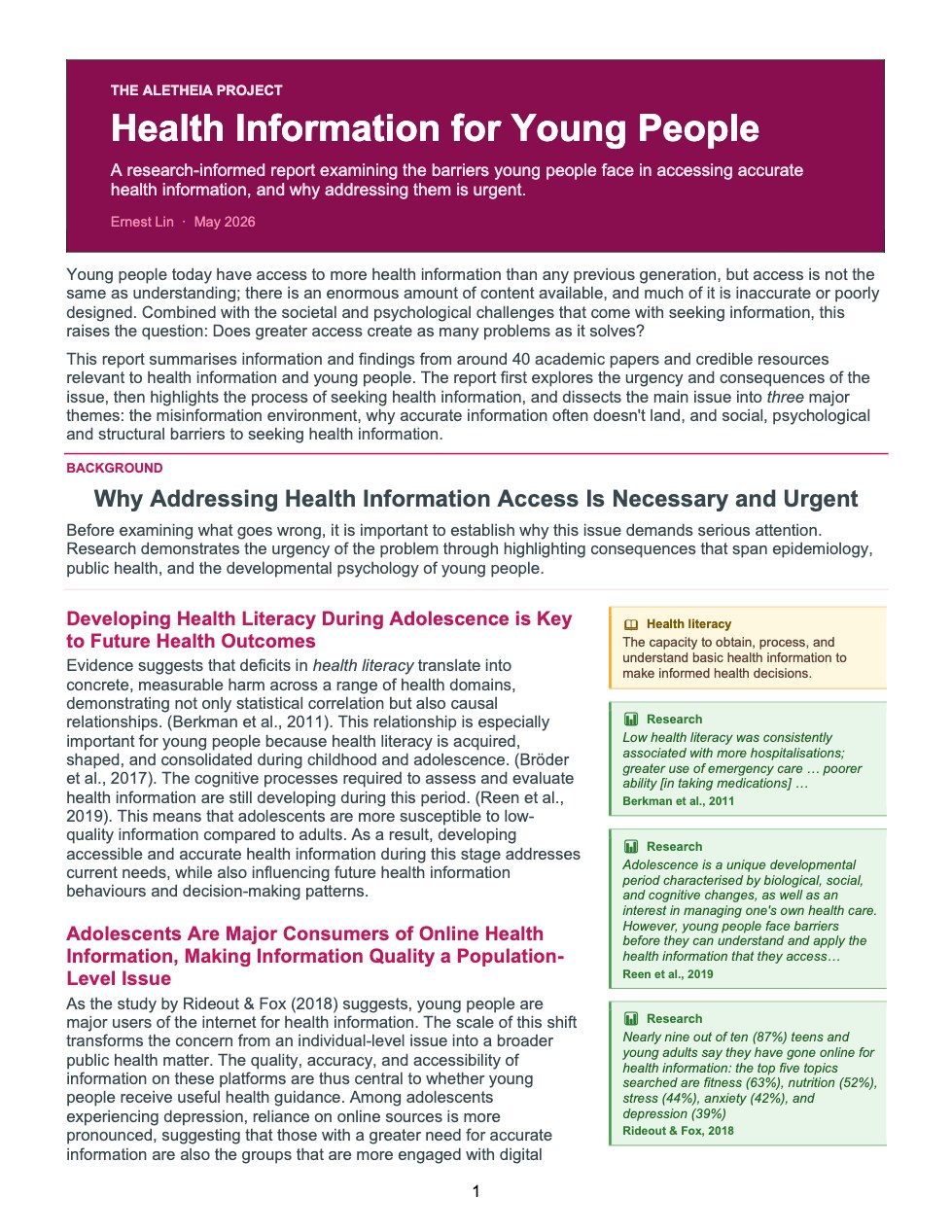
Health Information for Young People
By Ernest Lin · May 2026
Young people today have more health information at their fingertips than any generation before them. But access is not the same as understanding. Ernest's report asks whether greater access creates as many problems as it solves, and brings together findings from around 40 academic papers and credible sources to answer it.
The report explores why the issue is urgent, maps the process a young person goes through to find accurate health information, and breaks the barriers into three themes:
- The misinformation environment
- Why accurate information often doesn't land
- Social, psychological and structural barriers to seeking help