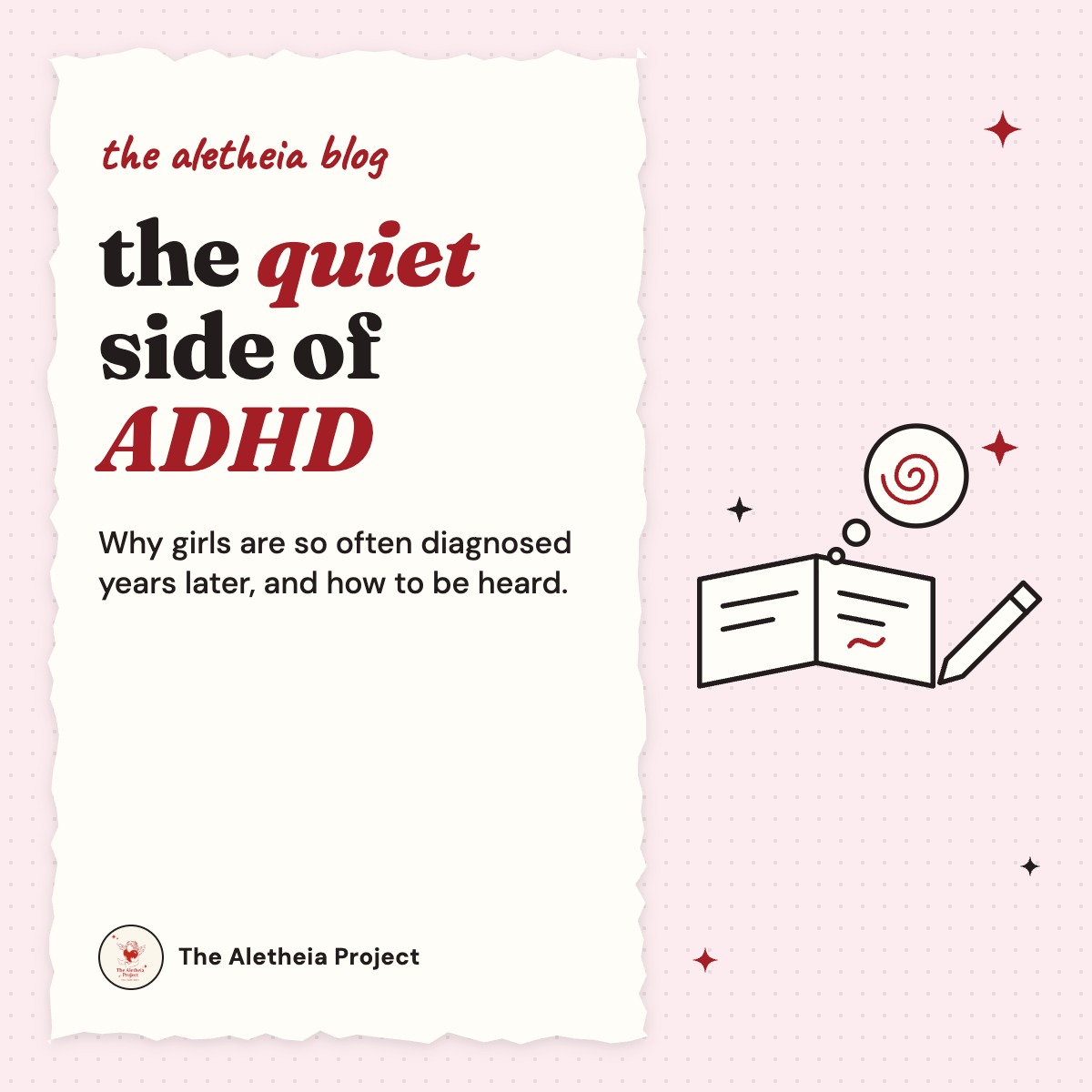
“she’s just a daydreamer”: adhd in girls and the late-diagnosis pattern
Every class has one. The girl who stares out the window. Who starts three assignments and finishes none of them on time. Who loses her hoodie, her charger, her train of thought. Who is “so bright, if only she applied herself”.
For a lot of girls, that sentence is the first sign of ADHD. It is also the sentence that keeps them from being noticed for years.
October is ADHD Awareness Month, so we want to talk about a very specific pattern: why ADHD in girls so often gets spotted late, what it can look like, and how to describe it to a GP so it is taken seriously.
the quiet version nobody pictures
When most people picture ADHD, they picture a boy bouncing off the classroom walls. That is one presentation. It is not the only one.
ADHD is usually described in three types: mostly inattentive, mostly hyperactive-impulsive, and combined. The inattentive type often looks like distraction, forgetfulness, losing things, and drifting off mid-task, without the obvious restlessness.
ReachOut notes that teen girls are more likely to have the inattentive type, which is less disruptive and so less likely to be noticed. That does not mean girls are less likely to have ADHD. It means they are less likely to be seen.
ADHD affects about 1 in 20 children in Australia. Quiet does not mean rare.
what masking looks like
“Masking” is when someone hides or compensates for their difficulties so they fit in. For girls with ADHD, that can look like:
- staying up late to redo work they could not focus on during the day
- colour-coded planners they rely on to hold everything together
- over-checking their bag, their messages, their notes
- being described as “chatty” or “dreamy” rather than struggling
- being exhausted after school from the effort of keeping up
From the outside, it can look like a capable student who is a bit disorganised. From the inside, it can feel like running twice as hard just to stay in the same place. Over time that effort can show up as stress, anxiety and low self-esteem, which then becomes the thing people notice instead.
“Bright but disorganised” is not a personality. Sometimes it is a pattern worth asking about.
the years in between
The late-diagnosis pattern is not just a feeling. A large Swedish population study published in 2024, looking at more than 85,000 people with ADHD, found that females were diagnosed at an average age of 23.5, compared with 19.6 for males. Females in the study were also about twice as likely to have an anxiety disorder (50.4% compared with 25.9%).
That is Sweden, not Australia, but the pattern rings true here too. When Australia released its first evidence-based ADHD clinical guideline in 2022, the team behind it pointed to a huge gap in what we know about how ADHD presents in girls and women.
Those in-between years matter. They are the years of school reports, friendships, first jobs and learning to drive, often carried out by someone who has quietly decided she is just “bad at life”.
how to describe it to a GP
Here is where health literacy helps. “I think I have ADHD” is a fine place to start, but specifics are what help a doctor understand. Before your appointment, write down:
- What happens: “I read the same paragraph five times and still can’t tell you what it said.”
- Where it happens: at school, at home, at work, with friends. ADHD shows up in more than one setting.
- How long: some signs need to have been present before age 12. Old school reports with comments like “easily distracted” can be useful.
- What it costs you: missed deadlines, lost things, friendships, sleep, how you feel about yourself.
- What you already do to cope: the alarms, lists and late nights are part of the picture.
A GP is the usual first step. ADHD cannot be diagnosed by an online quiz. Usually the GP will refer you to a paediatrician (for under-18s), a psychologist or a psychiatrist for a proper assessment, and in some states, including Victoria, GPs are being trained so they can diagnose ADHD too. Ask what the options and costs are where you live. Waitlists can be long, so it is worth starting early.
when you are not sure
Not every daydreamer has ADHD. Trouble concentrating can also come from anxiety, low mood, poor sleep, low iron, hearing or vision problems, or just a really hard year. That is exactly why a proper assessment matters, and why “it’s probably just stress” should be the start of the conversation, not the end of it.
If you feel brushed off, you are allowed to ask, “What else could explain this, and how would we check?” You are also allowed to get a second opinion.
what you can do
- Write it down before the appointment. Use the list above. Bring examples, not just labels.
- Bring a trusted adult if it helps. A parent, carer or school wellbeing staff member can add what they have noticed.
- Look after the anxiety too. If you are overwhelmed while you wait, Kids Helpline (1800 55 1800) and headspace can help now.
- Check on the quiet ones. If a friend keeps calling herself lazy or stupid, gently push back. It might not be either.
- Be kind to your past self. If you get a diagnosis later, it is not proof you failed. It is information you deserved earlier.
Girls with ADHD do not need to be louder to deserve help. They need the people around them to know what quiet struggle looks like.
In voice and solidarity,
The Aletheia Project
This post is general information, not medical advice. If you are worried about ADHD or your mental health, talk to a GP. In an emergency, call 000.
sources
- ReachOut Parents, ADHD in teenagers
- The Royal Children’s Hospital Melbourne, ADHD: an overview
- Raising Children Network, ADHD
- Learning Links, Signs of ADHD in girls
- PsyPost, Females with ADHD diagnosed four years later than males (on Skoglund et al., Journal of Child Psychology and Psychiatry, 2024)
- Monash University, Landmark new Australian ADHD guideline (2022)
- RACGP, Victorian GPs welcome ADHD reforms (February 2026)