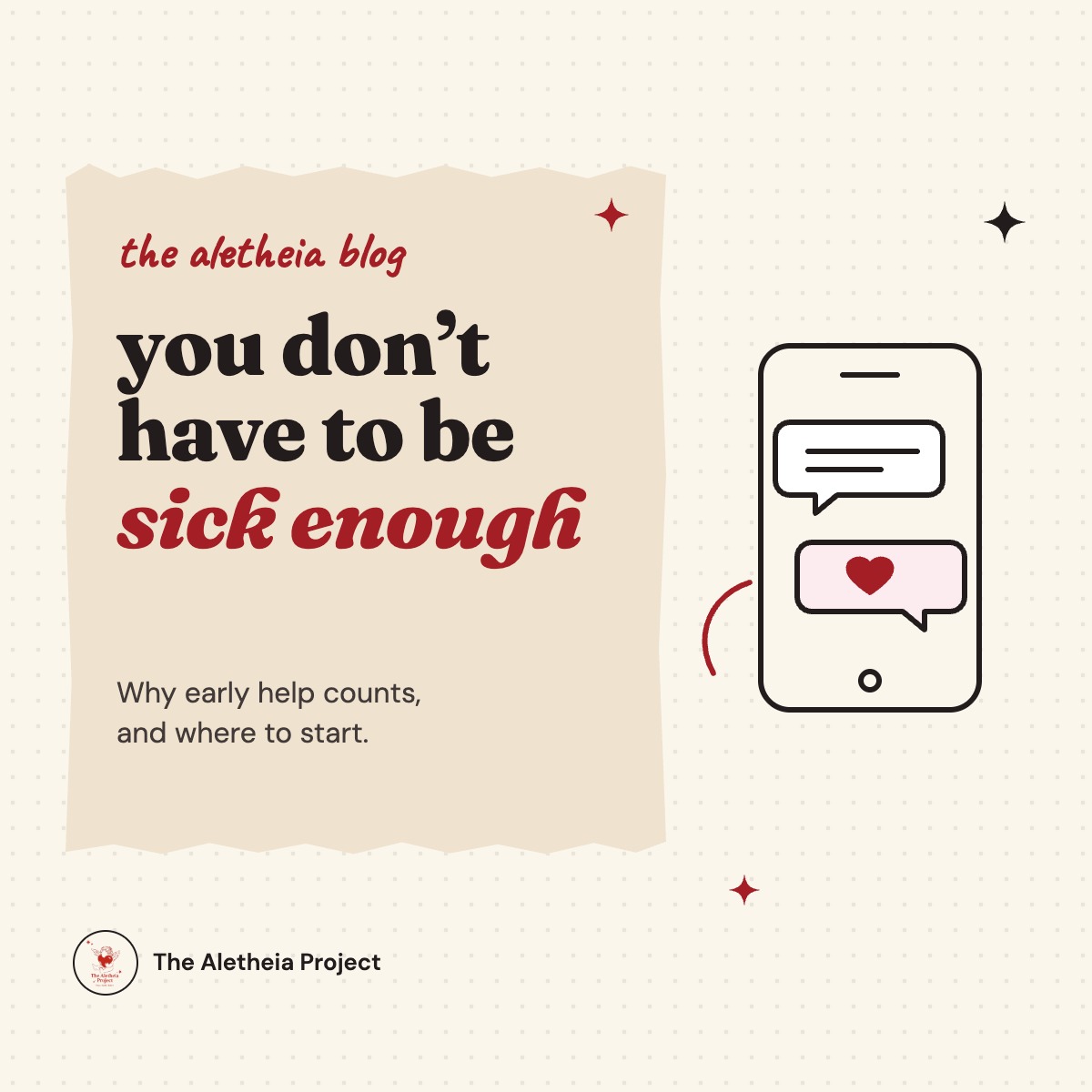
“i’m not sick enough”: the problem with waiting until it’s bad
Content note: this post talks about mental health and getting support. If you are not safe right now, call 000.
There is a sentence a lot of us say in our heads before we ever say it out loud.
“Other people have it worse. I’m not sick enough to ask for help.”
It sounds humble. It sounds fair, even. But it quietly sets a bar that keeps moving, and it keeps young people waiting outside the door until things get really hard. October is Mental Health Month in Australia, and this year’s theme from Mental Health Australia is “Together we Thrive”. So let’s talk about the bar, and why you don’t have to clear it.
where the “not sick enough” feeling comes from
Part of it is comparison. We see the worst stories online and in the news, and our own stuff looks small next to them.
Part of it is how we talk about help. A lot of us grew up hearing that doctors and counsellors are for emergencies, and that everything else is something you sort out yourself.
And part of it is not having the words. When you can’t name what is going on (“I just feel flat”, “I’m tired all the time”, “I can’t concentrate”), it is easy to decide it doesn’t count.
None of that means you are fine. It means you are guessing at a line that doesn’t exist.
what the numbers actually say
Mental health challenges are common for young people. According to the Australian Institute of Health and Welfare, about 39% of 16 to 24 year olds had a mental disorder in the previous 12 months in 2020 to 2022, up from 26% in 2007. For young women the figure was 46%.
But many people don’t get help. The Australian Bureau of Statistics found that fewer than half (45%) of Australians aged 16 to 85 with a 12-month mental disorder saw a health professional for their mental health in that time.
So “not sick enough” isn’t a rare thought. It is one reason so many people go without support they could have had.
You don’t have to earn support by getting worse. If it matters to you, it is worth talking about.
why earlier is better (and not scarier)
headspace describes its work as “early intervention” for 12 to 25 year olds. That phrase is the whole point. Services like this exist so that you can talk to someone while things are still small and messy, not only once they are big and loud.
Getting help early doesn’t mean something is badly wrong with you. It can look like:
- one conversation with a counsellor to sort out what is going on
- a GP helping you notice a pattern (sleep, mood, energy) and checking for physical causes too
- learning a couple of strategies that make exams, friendships or home a bit easier
- knowing who to call next time, before it builds up
Kids Helpline says it simply: “If it’s important to you, it’s important to us.” That is the right test. Not “is this bad enough?” but “is this bothering me?”
what you can say when you don’t know what to say
You don’t need a diagnosis or a perfect explanation to reach out. You can start with something like:
- “I’m not sure if this is a big deal, but I’ve been feeling off for a few weeks.”
- “I don’t really know what’s wrong. I just haven’t felt like myself.”
- “Can you help me work out whether I need support?”
Those sentences are enough. Working it out is the professional’s job, not something you have to do before you’re allowed in the room.
the support that is already there
Here are some places young people in Australia can go, from the most casual to the most urgent:
- Your school counsellor or wellbeing team. Often the closest and easiest first step.
- headspace (12 to 25). Centres across Australia, plus free online clinician chat from 3pm to 10pm.
- Your GP. They can talk through what’s happening and, if you are diagnosed with a condition such as anxiety or depression, write a mental health treatment plan so you can see a psychologist with a Medicare rebate. Healthdirect explains how that works.
- Kids Helpline (5 to 25). 1800 55 1800, 24/7, phone or webchat, about anything.
- Lifeline. 13 11 14, 24/7, crisis support.
- 000 if you or someone else is in immediate danger.
what you can do
- Swap the question. Instead of “am I sick enough?”, ask “has this been bothering me for a while?” If yes, that’s your answer.
- Write it down. A few notes on your phone (how you’re sleeping, how often you feel this way, what it stops you doing) makes the first conversation much easier.
- Pick the smallest first step. A webchat, a message to your school counsellor, or booking one GP appointment all count.
- Check on a friend. If a mate says “it’s not that bad”, you can tell them it doesn’t have to be. Offer to sit with them while they make the call.
- Talk about it out loud. The more normal it is to ask for help early, the fewer people wait until it’s a crisis. That’s what “Together we Thrive” looks like in real life.
This post is general information, not medical advice. If you are worried about your mental health, please talk to a health professional or one of the services above.
In voice and solidarity,
The Aletheia Project