“wait, who can see this?”: your my health record at 14
Somewhere in a government system, there is a file with your name on it. It holds your immunisations, the medicines you have been prescribed, maybe a pathology result or a hospital discharge summary. Until now, the person in charge of that file was probably a parent.
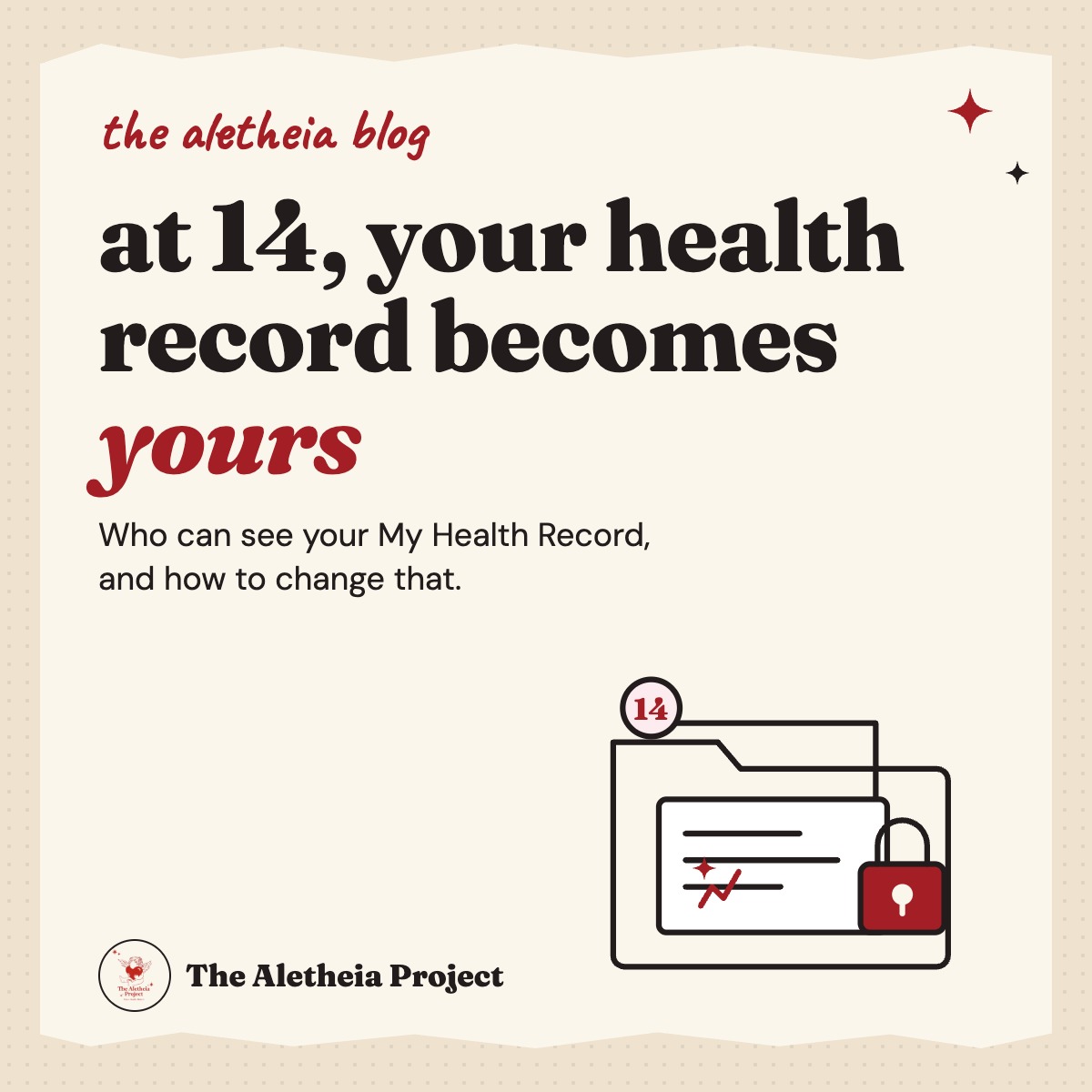
The day you turn 14, that quietly changes. Most people never notice. We think you should.
First, what is My Health Record?
My Health Record is Australia’s national online health summary. Health services can upload documents to it, like shared health summaries from your GP, test results, discharge summaries and records of what has been dispensed, and Medicare information such as Pharmaceutical Benefits Scheme (PBS) claims and immunisations can appear in it too.
The idea is that a doctor who has never met you can see the important stuff quickly, especially in an emergency. That is useful. It also means the record says a lot about you, which is exactly why it matters who can open it.
What changes at 14
Up until 14, a parent or guardian is automatically your “authorised representative”. That means they can view and manage your record on your behalf.
When you turn 14, that automatic access ends. The Australian Digital Health Agency puts it simply: when a child turns 14, all representatives are removed from their record. From then on, it is yours to manage.
The RACGP links this to the legal rights of a competent minor to seek medical care without a parent’s knowledge and consent. In other words, the system is built to recognise that a 14-year-old might reasonably see a GP about contraception, mental health or something they are not ready to share yet, and that the record should not quietly undo that confidentiality.
Two important details:
- You can invite a parent back in. If you want a parent, guardian or another trusted adult to keep helping, you can make them a “nominated representative”. You choose how much they can see or do.
- There is an exception. A parent who believes their child does not have the capacity to manage their own record can apply to keep control of it. This is not the usual path, but it exists.
Your health story is still yours when it is digital. Knowing who can open the file is part of knowing your own body.
The privacy settings almost nobody uses
By default, any healthcare organisation involved in your care can open your record. You can change that. Once you are managing your own record, you have a few real options:
- A Record Access Code. This is a 4 to 8 character code. Once it is set, new healthcare organisations cannot view your record unless you give them the code. Organisations that have already accessed it keep access, so you can remove them first if you want a fresh start.
- Restricted documents. You can mark individual documents as restricted, then set a Limited Document Access Code so only organisations you give that code to can see them.
- Removing documents. You can remove a document so you and your providers can no longer view it. Removed documents are not available in an emergency either.
- Asking for something not to be uploaded. You can ask a provider not to upload a document, and the OAIC says the provider must follow your request.
- Medicare information. You can choose whether Medicare details, such as PBS claims, appear in your record, and edit or remove them at any time.
- Alerts and access history. You can ask for an email or text when a healthcare organisation opens your record for the first time, and you can log in and see who has accessed it.
One honest caveat: in a medical emergency, providers can use emergency access to see your record, including restricted documents. That is a safety feature, and you can check your access history afterwards to see whether it was used.
Why this is a health literacy issue, not just a tech one
At Aletheia we talk a lot about confidentiality in the consult room. But confidentiality does not end when the appointment does. A record that a parent can browse, or that every new clinic can open without asking, shapes what young people feel safe telling a doctor.
We are not saying parents are the problem. For lots of young people, a parent is the most important support they have, and keeping them as a nominated representative is a great choice. The point is that it should be a choice, made on purpose, not something that happens by default because nobody explained the settings.
Knowing this stuff also helps in a practical way. If you are seeing a new specialist, you can check what is in your record before you go. If a result is uploaded, you may be able to see it yourself. And if something is wrong or missing, you can raise it with the provider who uploaded it.
How to actually get in
You access My Health Record through myGov, by linking it as a service. You will need to verify your identity, and your Medicare card is part of that, which is one more reason having your own card can help. If the online steps get confusing, the My Health Record help line is 1800 723 471.
If you do not want a My Health Record at all, you can also cancel it. Think about that carefully: cancelling means the information is gone, including in an emergency.
What you can do
- Check whether you have a record. Log in through myGov, or ask a trusted adult to help you set up access.
- Decide who you want in. If you want a parent to stay involved, add them as a nominated representative and choose their level of access.
- Look at your access list. Remove any organisations you do not want to keep access, then consider setting a Record Access Code.
- Turn on notifications. A text when a new organisation opens your record is a simple safety net.
- Ask your GP. It is completely fine to say, “Will this be uploaded to my My Health Record? Can we talk about that first?”
- Get support if you need it. If questions about privacy are connected to something harder, like feeling unsafe at home, you can talk to Kids Helpline on 1800 55 1800 (any time, ages 5 to 25) or 1800RESPECT on 1800 737 732. In an emergency, call 000.
This post is general information, not medical or legal advice. Settings and rules can change, so check the official pages below for the latest.
In voice and solidarity,
The Aletheia Project
Sources
- Australian Digital Health Agency: View and manage a child’s record
- RACGP: My Health Record, children and young people
- OAIC: Manage your My Health Record
- Australian Digital Health Agency: Restrict access to your record
- Australian Digital Health Agency: Restrict access to documents in your record
- Perth Children’s Hospital: My Health Record
- Kids Helpline