
pain scales in health + how to use them!
Talking about pain is hard. Especially when you’re young, or when you’ve been told to downplay it your whole life. At Aletheia, we know how easy it is to sit in a doctor’s office and suddenly feel like your words aren’t enough — like you need proof just to be believed.
That’s where pain scales come in. They sound simple (“pick a number between 1 and 10”), but actually using them in a way that shows the truth of what you’re feeling? That takes practice. And that’s what we’re here to unpack together.
everyone are allowed to be themselves and not feel like they have to cater to a “specific” pain scale :))
why numbers are trickyy..
“On a scale of 1 to 10, how bad is your pain?”
You’ve probably been asked this at some point. Maybe by a doctor, maybe by a nurse, maybe even by a parent. And honestly? It’s one of the most awkward questions ever. Like… what exactly is a 10? Am I supposed to compare this to stepping on Lego, or getting hit by a truck?
The thing is, pain scales are supposed to help. They’re meant to give you a way to explain something only you can feel. But the problem is, everyone’s 10 looks different. For one person, a 10 might be period cramps so bad they’re throwing up on the bathroom floor. For someone else, a 10 might be breaking their arm and crying all the way to the ER. Both are real. Both are valid. And both make sense as a “10.”
That’s the trick with pain scales — they’re personal. And learning how to use them isn’t about finding the “right” number, it’s about finding the words and examples that make doctors actually get what you’re going through.
And it’s not just you, so many of us underreport because we don’t want to seem dramatic, or because we’ve been trained to keep our pain small. But here’s the catch: doctors don’t always pick up on that. If you say “eh, it’s a 4” when you’re actually curled up in bed missing school, they’ll take you at your word and move on.
That’s why numbers feel tricky — they’re personal, but the world keeps treating them like they’re universal.
really funny example →
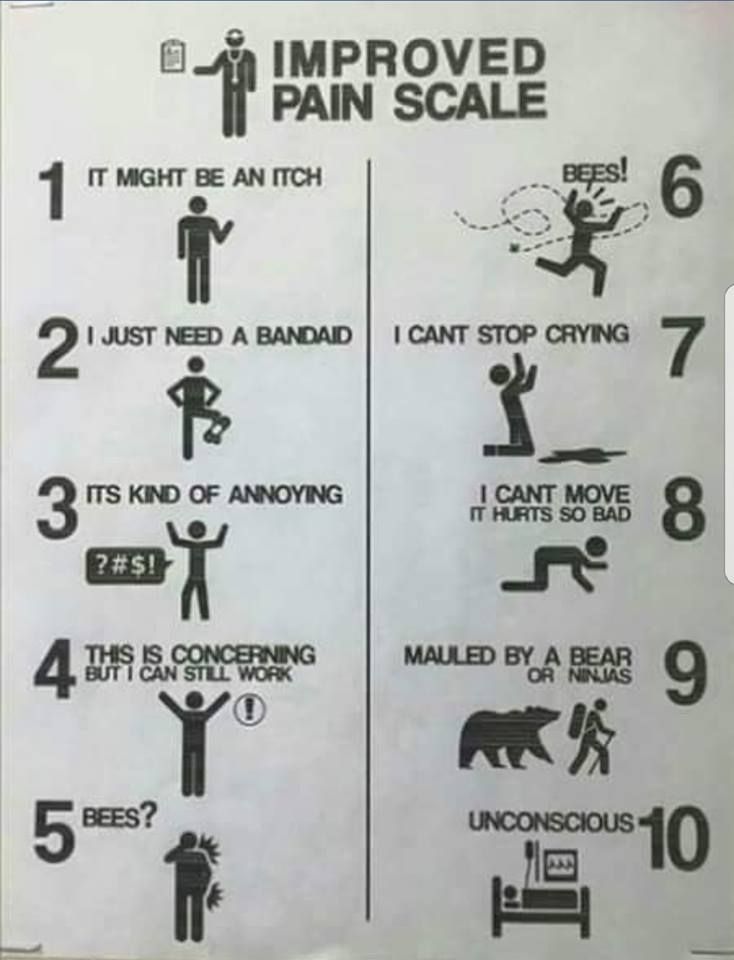
why does this matter?
Here’s why this little numbers game isn’t just awkward – it matters. Because when you downplay your pain, the people listening (doctors, nurses, whoever’s in the room) will too. They’ll assume it’s “not that bad,” and you’ll walk out with less help than you actually need.
Think about it: if you tell a doctor your pain is a “4,” they’re not picturing you curled up in bed, missing school, skipping sport, and crying into a heat pack. They’re picturing you managing just fine, maybe a bit uncomfortable, but still functioning. That gap – between how it feels and how it sounds when you put a low number on it – is where dismissal sneaks in.
And that’s why using pain scales well is about more than picking a number. It’s about making sure your number tells the whole story. Your pain doesn’t have to match anyone else’s version to be valid. If it’s a 7 for you, it’s a 7. Full stop.
When you give yourself permission to be honest on the scale, you give doctors a chance to actually see you. And that can be the difference between being brushed off and being believed.
how to make pain scales work for you
Okay, so if everyone’s numbers are different, how do you make pain scales actually work? The trick is to anchor them in your life, not someone else’s. Doctors don’t live in your body, so you’ve got to show them what each number really looks like for you.
Here’s how:
-
A 3 might be when you’re still able to go to school, do homework, maybe even laugh with friends, but the pain is sitting in the background like an annoying mosquito you can’t swat away.
-
A 7 might be when you’re curled up in bed with a heat pack, cancelling plans, scrolling on your phone but not really reading anything because the pain keeps pulling you out.
-
A 9 could be when you’re crying, unable to walk properly, or the pain is so sharp it takes your breath away and you’re wondering if you should go to the hospital.
See how that paints a picture? Numbers mean more when you attach them to real-life situations.
And if you’re stuck, it can help to make your own little “pain scale map.” For example, here’s what mine (our aletheia director’s version!) looks like:
-
1 = background ache, kind of annoying but I can still do literally everything I’d normally do.
-
3 = it’s distracting, I keep shifting in my chair in class, but I can still power through.
-
5 = I’m struggling to focus, maybe skipping sport, needing Panadol or a heat pack to get through.
-
7 = I cancel plans, lie down most of the day, pain is controlling my choices now.
-
8 = I’m crying, nauseous, can’t sleep through it, nothing touches the pain.
-
10 = I’m blacking out or vomiting, wondering if this is “hospital-level bad.”
That’s my list. Yours might look totally different and that’s the point. Pain scales aren’t about matching anyone else’s numbers. They’re about translating your pain into something a doctor can’t just brush off.
And one more thing: don’t shrink your number to sound tough. You don’t win points for suffering quietly. Saying “it was a 9” doesn’t make you dramatic. It makes you honest. And that honesty gives you the best chance of being believed.
teensy little tips that help!
Okay, so now you’ve got your pain scale “map.” But what about actually using it when the moment comes? Here are some little tricks that make a big difference:
1. Keep a pain diary
It doesn’t have to be fancy. Notes app on your phone. A scrappy notebook. Even the back of your school diary. Just jot down:
-
Number: “Pain was an 8 today.”
-
Words: stabbing, burning, throbbing, dull ache.
-
Impact: “Missed sport.” “Couldn’t sleep.” “Needed to leave class.”
Example entry:
Tuesday: pain at 7, stabbing, couldn’t concentrate in class, cried in the bathroom, heat pack helped a little.
This way you’re not scrambling in the doctor’s office trying to remember — you’ve got receipts.
2. Bring real-life examples
Doctors love concrete details. Instead of just saying “sometimes it’s a 9,” say:
“Last Tuesday it hit a 9. I was vomiting, couldn’t leave bed, missed school completely.”
That makes it harder for them to shrug it off, because they can picture the impact.
3. Anchor your numbers
Link them to everyday life so they make sense outside your body:
-
3 = I can still do homework, but I’m fidgety and distracted.
-
6 = I skipped sport, couldn’t sit through class, needed Panadol.
-
9 = I cried, couldn’t stand upright, couldn’t eat.
You don’t have to be exact every time, but having these “anchors” stops you from doubting yourself when you’re put on the spot.
4. Remember: your 6 might be someone else’s 10
And that’s okay. Pain is personal. You don’t need to downgrade your number just because someone else says “oh, mine was a 10 when I broke my arm.” Your body is your body. Your scale is your scale. Full stop.
The whole point isn’t to prove you’re suffering “enough.” It’s to give yourself language that gets you taken seriously, so your pain doesn’t get brushed into silence.
aletheia’s reminder
Pain scales aren’t about proving you’re strong enough or sick enough. They’re not a competition, and there’s no “perfect number.” They’re just a tool — a way to put what you feel into words and numbers so someone else can finally understand.
Your pain doesn’t have to look like anyone else’s to matter. If it feels like a 7 to you, it’s a 7. If it stops you from living your day, it deserves to be heard.
You don’t need to shrink your truth to fit a scale. The scale exists to fit you.
And you will know that if you ever need any support online (alongside parents, guardians, friends, counselors, and any wellbeing services!) you know where to find us ;))
All the love,
The Aletheia Project
Originally published by The Aletheia Project on Substack.