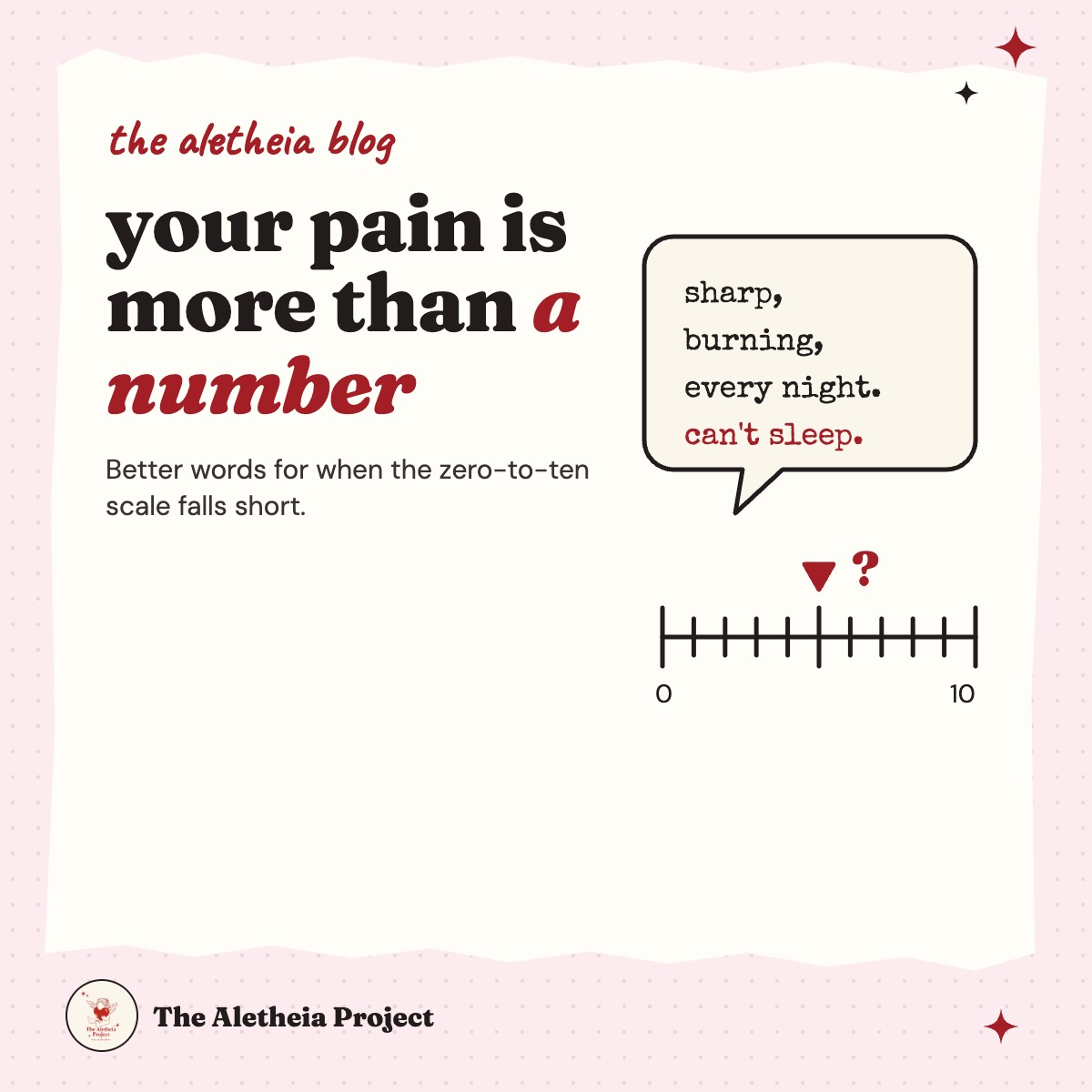
“rate your pain out of 10”: why the number isn’t the whole story
You are sitting on the edge of an exam table. Something has hurt for weeks. The doctor looks up from the screen and asks the question everyone asks: “On a scale of zero to ten, how bad is the pain?”
And your brain stalls. Is it a six? Is a six dramatic? What would a ten even feel like? You say “maybe a five?” and watch it get typed in. Somehow, weeks of your life have just become one number.
If that has happened to you, you are not bad at describing pain. The scale was never built to carry the whole story on its own.
What the number is actually for
The zero-to-ten scale is a quick, useful tool. It helps a clinician see whether pain is getting better or worse over time, or whether a treatment is working. Asked on the same day, in the same way, it can show change.
What it cannot do is explain your pain. It does not say where it is, what it feels like, when it started, or what it is stopping you from doing. Better Health Channel points out that pain is personal: the brain interprets pain signals through past experience, expectations, culture, mood and what we have learnt is “normal” to complain about. Two people can have the same injury and give completely different numbers.
So a “four” from someone who was raised to tough it out might mean more than an “eight” from someone else. Neither is lying. The number just means different things to different people.
Why young people get stuck on the scale
There are a few reasons the scale can go especially wrong for teenagers and young adults.
- You may not have a reference point. If you have never broken a bone or had surgery, you have no idea what a “ten” is meant to be. So you round down, just in case.
- You have adapted. When pain is ongoing, people learn to function through it. You still go to school or work, so it feels wrong to call it severe, even when it is wearing you down.
- You are worried about not being believed. Say a high number and you might seem dramatic. Say a low number and you might be sent home. Many of us pick the safe middle.
That last one matters. The National Kids in Pain Report 2025, commissioned by Chronic Pain Australia, found that families of children and young people with chronic pain had been told the pain was anxiety (71%), “growing pains” (54%) or attention-seeking (35%). About one in five Australian children live with chronic pain, and many families waited years for answers. When dismissal is that common, it makes sense that young people second-guess their own number.
Your pain is not a test you can fail. A number starts the conversation. Your words finish it.
Better words than a number
The good news is that clinicians are trained to use far more than the scale, and you can help by giving them more to work with. Think about five things.
- What it feels like. Try specific words: aching, cramping, burning, sharp, stabbing, shooting, throbbing, heavy, tender, gnawing. “A burning pain” and “a dull ache” can point in very different directions.
- Where it is. Does it stay in one spot or spread? Point to it if that is easier than naming it.
- When it happens. When did it start? Is it constant, or does it come and go? How long does each episode last? Is it worse at a certain time of day, or a certain time of the month?
- What changes it. What makes it worse (moving, eating, sitting, your period, stress) and what helps (rest, heat, medicine)? If medicine helps, say what you take and how much.
- What it stops you doing. This is the one people skip, and it is often the most powerful. “I have missed six days of school this term.” “I can’t sleep through the night.” “I stopped going to training.” These are facts, not feelings, and they are hard to wave away.
Better Health Channel also suggests mentioning how pain affects your sleep, appetite and daily life, plus any other conditions and all the medicines you take, including over-the-counter ones.
How to answer the question when it comes
You do not have to refuse the scale. You can give the number and then add context. Some ways to say it:
- “Right now it is about a four, but at its worst it is an eight, and that happens most mornings.”
- “I’d say a five, but I’m used to it. It has been there every day for two months.”
- “I honestly don’t know what number to give. Can I describe it instead?”
- “It’s a five, and it means I can’t concentrate in class or sleep properly.”
That last sentence does more work than any number ever could.
Keep a simple pain diary
Memory is unreliable, especially in a short appointment when you are nervous. A pain diary fixes that. It does not need an app. A notes page on your phone works.
Each day, jot down: the date, a rough number, one or two words for how it feels, where it is, what you were doing, and anything that helped or made it worse. If you have periods, note where you are in your cycle. After two or three weeks you will have a pattern you can show, not just tell.
Bring it to your appointment. It is completely fine to say, “I’ve been keeping track. Can I show you?”
What you can do
- Before your appointment, write down your five things: feel, place, timing, triggers and impact.
- In the room, give your number and then add one sentence about what the pain stops you doing.
- If you feel brushed off, ask, “What else could this be?” or “If it doesn’t improve, what’s the next step?” You can also ask for a second opinion.
- If pain has lasted more than three months, it is worth asking your GP whether it could be chronic pain and whether a referral to a specialist or pain service makes sense.
- Get help fast for sudden, severe pain, chest pain, or pain with trouble breathing: call 000. For non-urgent advice any time, healthdirect’s free helpline is 1800 022 222. If pain is getting you down, Kids Helpline (1800 55 1800, ages 5 to 25) and Lifeline (13 11 14) are there.
This post is general information, not medical advice. If something hurts, it is worth getting checked.
Your pain is real at a two and real at a nine. You are allowed to take up space with it.
In voice and solidarity,
The Aletheia Project
Sources
- Better Health Channel: Pain and pain management
- UTS / The Conversation: Not just growing pains: 1 in 5 Australian kids live with chronic pain (National Kids in Pain Report 2025)
- Painaustralia: Children and young people
- healthdirect: Chronic pain
- NICHD: How can I describe my pain to my health care provider?