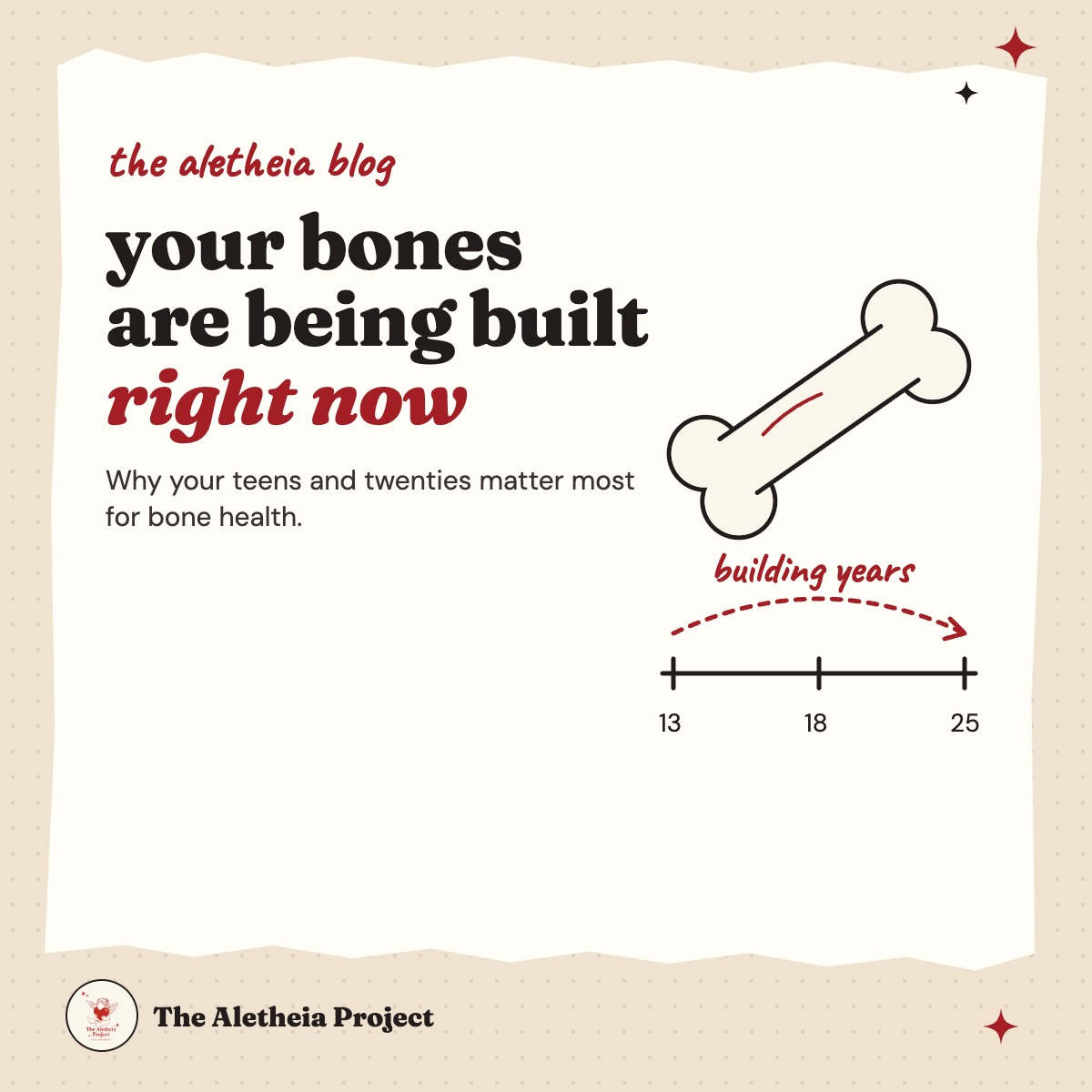
“i’ll worry about my bones later”: why your teens and twenties matter most
Content note: this post briefly mentions under-eating and eating disorders. Support details are at the end.
Osteoporosis sounds like a grandparent problem. Brittle bones, a broken hip, a bone density scan at 70. Not exactly something you think about between classes.
Here is the twist: a lot of what decides your bone health at 70 is happening right now, in your teens and twenties. Tuesday 20 October is World Osteoporosis Day, so we are taking the topic back from the over-50s for a minute.
Your skeleton has a deadline (sort of)
Bone is living tissue. Your body is constantly breaking old bone down and building new bone, which is also how fractures heal. During childhood and adolescence, your body builds more than it removes, so bones get bigger and denser.
According to Healthy Bones Australia, you reach your peak bone mass, the strongest and densest your bones will ever be, in your twenties. A Medical Journal of Australia review describes the two years around puberty as a key window, when about 40% of adult peak bone mass is gained.
After that, the goal shifts from building to keeping. healthdirect notes bones gradually lose density from your 40s onwards. So the higher your peak, the more you have in the bank.
You are not too young to think about your bones. You are exactly the right age.
Calcium: more than you probably think
Australia’s nutrient reference values recommend 1,300 mg of calcium a day for 12 to 18 year olds, dropping to 1,000 mg for adults aged 19 to 30. That teen number is higher than most adults need, because your skeleton is growing fast.
What does 1,300 mg look like? Better Health Channel gives some rough guides:
- A cup of milk, a 200 g tub of yoghurt, or a cup of calcium-fortified soy milk: about 300 mg each
- Half a cup of canned salmon with the bones: about 310 mg
- Firm tofu (depending on the type): can be very high, around 800 mg per cup
- Fortified breakfast cereal or bread: up to about 200 mg a serve
If you do not eat dairy, that is fine, but it is worth checking that your plant milk is calcium-fortified. Spinach is often called a calcium food, yet Better Health Channel notes only about 5% of its calcium is absorbed. Broccoli does much better.
The MJA review found many teenage girls, and a large share of teenage boys, were not getting enough. Food first is the advice; supplements are something to talk through with a GP, not grab on a whim.
Vitamin D and the sun
Vitamin D helps your body absorb calcium. Most of it comes from sunlight on skin.
Cancer Council Australia says that when the UV index is 3 or above, you still need sun protection, and most people get enough vitamin D from brief, incidental time outdoors on most days. In southern states in late autumn and winter, when UV is below 3, some time outside around midday with some skin uncovered helps. Sunscreen has minimal effect on vitamin D over time, so this is not a reason to skip it.
Some people are at higher risk of low vitamin D, including people with naturally dark skin and people who cover their skin for cultural or religious reasons. If that is you, it is reasonable to ask your GP whether a test or supplement makes sense.
Move like your bones are listening
Bones respond to load. When you put force through them, they adapt and get stronger. The MJA review calls childhood and adolescence the optimal window for exercise to strengthen bones, and suggests at least 30 minutes of weight-bearing activity on three to five days a week.
Weight-bearing means you are holding yourself up against gravity. Running, netball, basketball, dancing, skipping, jumping and strength training all count. Swimming and cycling are brilliant for your heart, but they are not weight-bearing, so mix it up if those are your main sports.
What quietly works against you
This is the part we rarely hear about.
- Under-eating. Healthy Bones Australia explains that very low body weight can cause the body to stop or sharply reduce oestrogen production, often stopping periods, which greatly affects bone growth and strength. Eating disorders such as anorexia nervosa can stop the skeleton reaching its peak.
- Periods that go missing. If your periods stop for months and you are not pregnant, that is a signal worth taking to a GP, not a convenience. This includes athletes training hard on not enough food.
- Smoking and heavy drinking. Both are linked to weaker bone.
- Some health conditions and medicines. Healthy Bones Australia lists undiagnosed coeliac disease, some thyroid conditions, long-term corticosteroids and certain epilepsy medicines among the risk factors in younger people.
None of this is about panicking. It is about knowing that “bone health” is not just an old person’s concern, so you can mention it if something on that list applies to you.
What you can do
- Count your calcium for a day. Not forever, just once, to see where you sit against 1,300 mg.
- Check your plant milk label for “calcium-fortified” if you skip dairy.
- Add some impact. A few minutes of jumping, skipping or running on most days adds up.
- Get outside for short, sun-safe stretches, especially in winter.
- Speak up if your periods have stopped, if you have a condition or medicine on the list above, or if you have broken a bone from a minor fall. You can ask, “Should we be thinking about my bone health?”
- Reach out if food or body image feels hard. The Butterfly Foundation National Helpline is 1800 33 4673, Kids Helpline is 1800 55 1800 (ages 5 to 25), and Lifeline is 13 11 14. In an emergency, call 000.
This post is general information, not medical advice. Your GP can help you work out what applies to you.
Future you will not remember the yoghurt or the netball training. Their bones will.
In voice and solidarity,
The Aletheia Project
Sources
- Healthy Bones Australia: Youth Hub
- Healthy Bones Australia: Anorexia nervosa and bone health
- Medical Journal of Australia: Building healthy bones throughout life
- Eat For Health (NHMRC): Calcium nutrient reference values
- Better Health Channel: Calcium
- Cancer Council Australia: Vitamin D
- healthdirect: Healthy bones