“just checking in”: when care turns into control
Content note: this post talks about coercive control and abuse in relationships. If you’re in danger right now, call 000. For support any time, call 1800RESPECT on 1800 737 732 or Kids Helpline on 1800 55 1800.
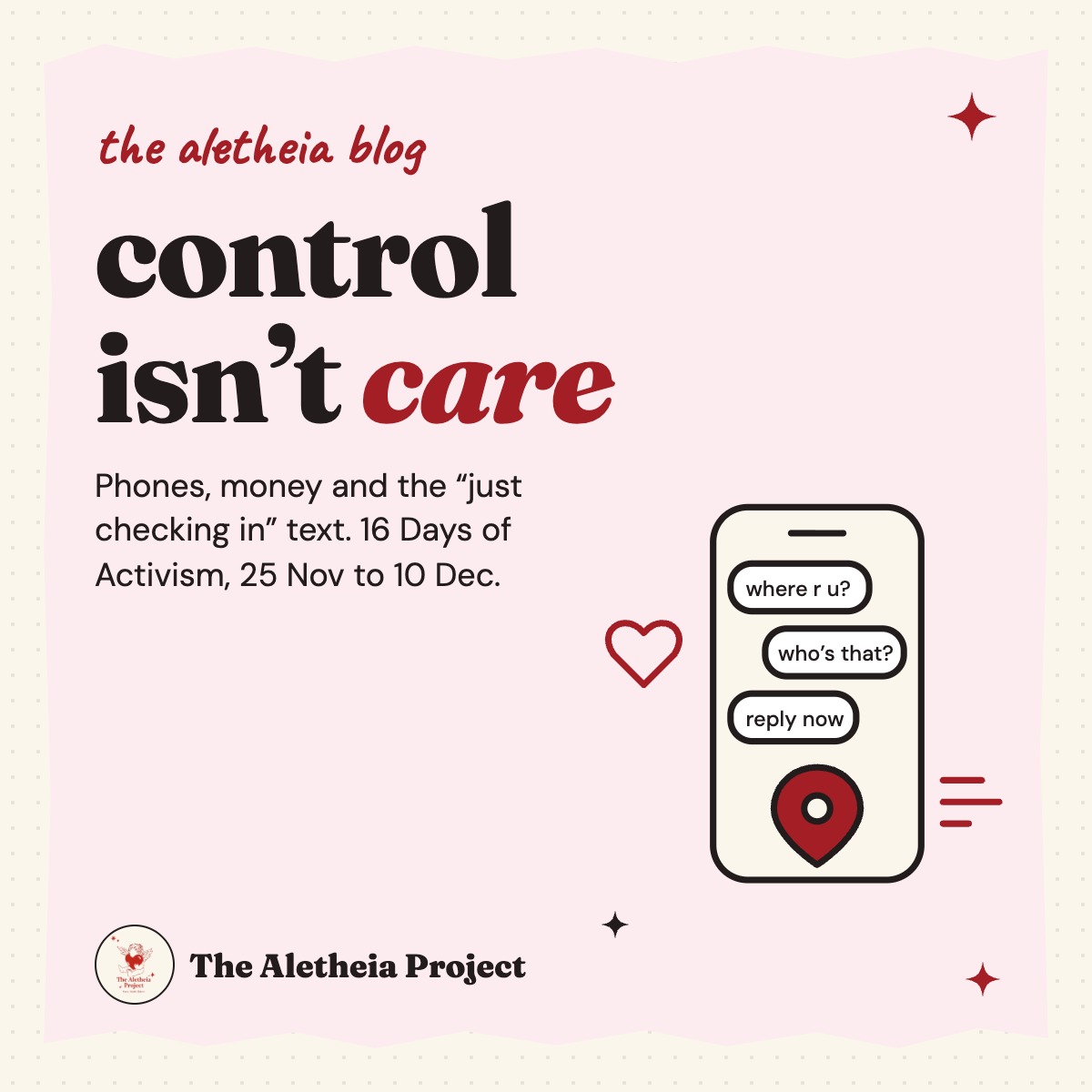
“Where are you?”
“Who’s that in your story?”
“Why didn’t you reply? I was worried.”
On their own, none of these texts sounds like abuse. Most of us have sent something like them. That’s exactly why coercive control is so hard to spot, especially when you’re young and still working out what a relationship is meant to feel like.
From 25 November to 10 December, the world marks the 16 Days of Activism against Gender-Based Violence. This year’s UN Women theme is “Ensure justice, protect survivors, end impunity.” We want to start somewhere smaller and closer to home: your phone, your money, and the line between someone caring about you and someone controlling you.
So what is coercive control?
The Attorney-General’s Department describes coercive control as a pattern of abusive behaviour that, over time, creates fear and takes away a person’s freedom and independence. It can be physical or non-physical, and it can happen in person or online. It can be used against anyone in any relationship, though it is mostly used by men against women. It can also keep going after a relationship ends.
The key word is pattern. One jealous moment isn’t coercive control. A steady build-up of checking, rules, guilt and fear is.
It often starts by feeling amazing
This is the part nobody warns you about. According to the Attorney-General’s Department guide for young people, early on a partner might be overly affectionate, constantly flatter you, shower you with gifts, say “I love you” very early, and want to be with you or messaging you all the time. This is sometimes called love bombing.
It feels like being chosen. Then, slowly, the attention starts to come with conditions.
Over time, the same guide says, a partner may start to control who you see, what you wear and where you go, closely monitor your social media or track your location, get jealous easily, put you down, or pressure you into sex or sending nudes. They may say things like “If you loved me you would…”
And you might notice you feel like you’re walking on eggshells, or like you need permission to do normal things.
When the phone becomes the leash
For young people, so much of this happens on a screen. eSafety lists warning signs like obsessive texting or calling, wanting to know what you’re doing all the time, monitoring your social media, and pressure to share intimate images. It notes these red flags are often dismissed as signs of love.
The numbers show how blurry that line has become. In a 2025 eSafety survey of young Australians aged 18 to 24:
- only 2 in 5 understood the term “coercive control”
- nearly 1 in 5 thought it was okay to track a partner whenever they want
- almost 1 in 3 believed constantly texting a partner to ask what they’re doing and who they’re with is a sign of care
- almost 3 in 10 said insisting on checking how a partner looks in a photo before it’s posted is a reasonable request
So if you’ve ever thought “maybe this is just what relationships are like now”, you’re not alone. But common isn’t the same as okay.
“Love doesn’t need your location, your passwords or your pay slip to prove itself.”
Money, friends and the quieter signs
Control isn’t only about phones. The NSW Government lists financial abuse as one form of coercive control: controlling or limiting someone’s access to money, or strictly monitoring what they spend. For a teenager, that could look like someone demanding to see your bank app, expecting your casual-job pay, or making you feel you owe them.
It can also look like slowly losing your people. You stop seeing certain friends because it “causes drama”. You skip things because it’s easier than the argument afterwards. You used to be loud and now you’re careful.
It doesn’t only happen between partners, either. ANROWS reports that Kids Helpline data shared with Triple J Hack showed more than 1,000 young people contacted the service between January 2024 and July 2025 describing coercive control-type behaviours in their peer relationships, and many involved close friendships rather than romance.
Why it’s so hard to name
At Aletheia we talk a lot about not having the words for what’s happening to you. Coercive control is a clear example. If no one ever told you that constant checking or location sharing on demand can be a warning sign, it just feels like the cost of being loved.
eSafety also points out why young people stay: strong feelings from the early love-bombing stage, fear, low self-esteem, and the way controlling behaviour gets romanticised in friend groups and pop culture. None of that is a personal failing. It’s how this kind of abuse works.
Naming it isn’t about labelling someone a villain overnight. It’s about giving yourself permission to notice.
What you can do
- Check in with yourself: do you feel freer or smaller in this relationship? Can you say no, disagree or see friends without paying for it later?
- Know that healthy looks different: a partner or friend who cares will be glad you’re safe home, not furious you didn’t report in. Location sharing, if you do it, should be your choice and easy to switch off.
- Tell someone you trust: a friend, family member, teacher, school counsellor or GP. You don’t need to be certain it’s “bad enough”.
- If you’re worried about a friend: stay close, listen without judging, and avoid ultimatums. Isolation is part of how control works, so just staying in their life matters.
- Reach out for support: 1800RESPECT (1800 737 732, text 0458 737 732, or online chat, 24/7), Kids Helpline (1800 55 1800, for young people up to 25), or headspace (1800 650 890). In an emergency, call 000.
Care sounds like “text me when you’re home safe.” Control sounds like “why weren’t you home when you said you would be?” You’re allowed to notice the difference, and you’re allowed to want more than being watched.
In voice and solidarity,
The Aletheia Project
This post is general information, not legal or medical advice. If you’re worried about your safety or someone else’s, contact one of the services above.
Sources
- Attorney-General’s Department, Young People and Relationships: Identifying Coercive Control
- Attorney-General’s Department, Coercive control
- eSafety Commissioner, When ‘love’ becomes control
- NSW Government, What are the signs of coercive control?
- ANROWS, Coercive control, gaslighting and the digital lives of young people: what we need to hear
- UN Women Asia and the Pacific, 16 Days of Activism 2026: Ensure justice, protect survivors, end impunity